Stellar Evolution: How a Star is Born?
Gazing into the night sky, each individual star you see is not just a point of light – it is a cosmic time machine, a furnace where the very elements composing our world and ourselves were shaped. But how do these stars come to life, burn in brilliant cycles and evolve, and ultimately die and scatter materials for everything from planets to diamonds into the universe? Here’s an epic story of stellar formation and evolution, unfolding over billions of years and setting the stage for everything we know.
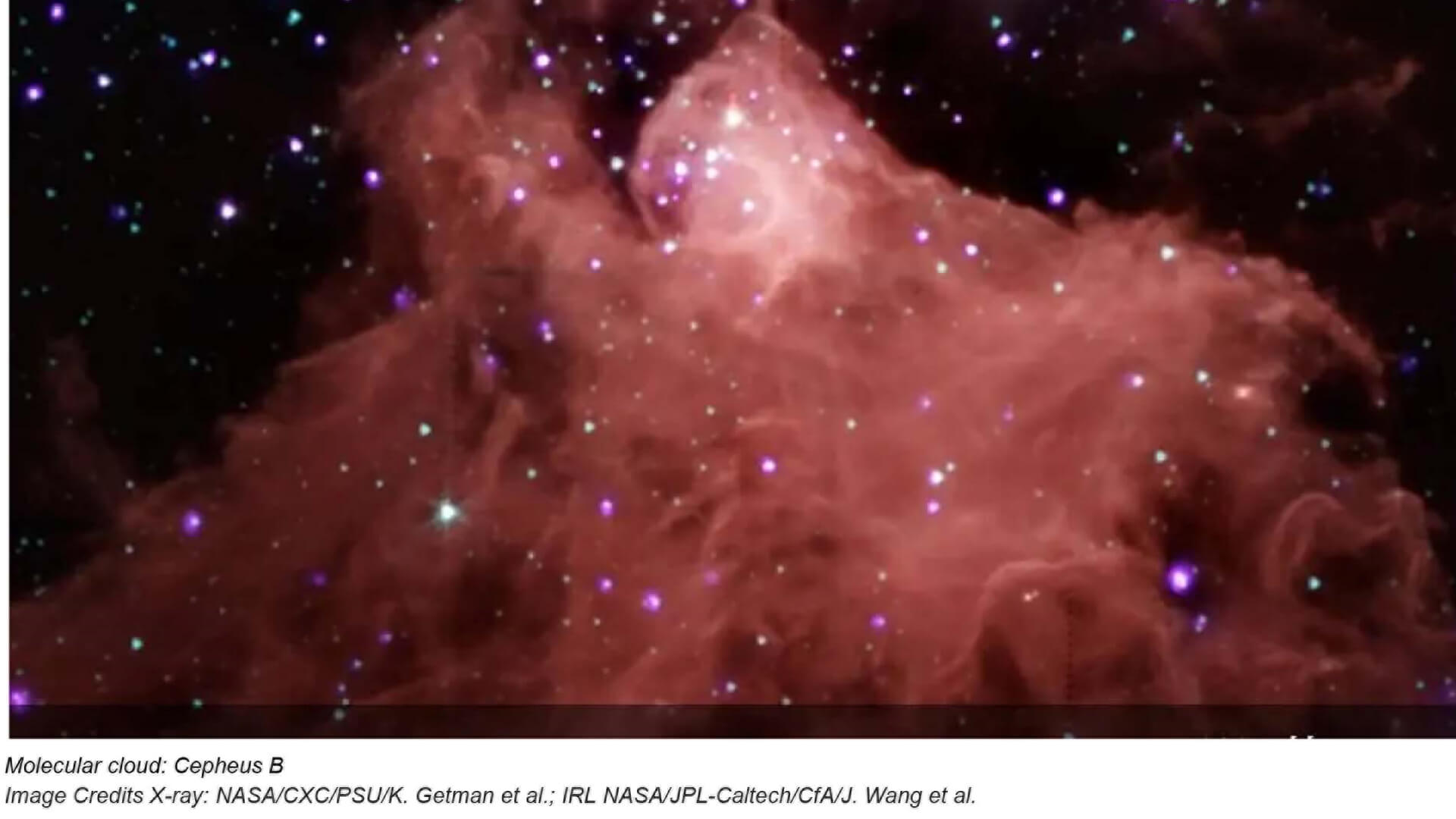
Molecular cloud: Cepheus B
Image Credits X-ray: NASA/CXC/PSU/K. Getman et al.; IRL NASA/JPL-Caltech/CfA/J. Wang et al.
It all begins in vast, frigid molecular clouds – composed of dust and gas, mostly hydrogen and helium, swirling around. Occasionally, small regions within these clouds become so dense that gravity overcomes all other forces, accumulating tiny particles, increasing mass, and triggering a dramatic collapse. Once this condensation reaches a critical mass, gravity compresses to a protostar – a star that does not have a nuclear fusion in its core.
The “birth” of a star starts when enough mass gathers from these molecular clouds, compressing, increasing the temperature, and hydrogen atoms smashing together. When temperature spikes past 10 million Kelvins, hydrogen atoms will fuse into helium – releasing immense energy, marking the birth of a true star.
Materials press in as gravity; energy from nuclear fusion pushes out. A perfect balance between the two forces makes the star stable. When a star has used up most of its hydrogen to fuse into helium in its core, this nuclear reaction stops, and gravity resumes to collapse further. It will become denser and hotter until the temperature and pressures of the interior are enough to start fusing helium into heavier elements, and the process continues.
Stars begin their adult life as “main sequence” stars, just like the current state of our Sun. Stars spend most of their life in the main sequence. Lower mass stars shine quietly for billions of years, while more massive stars burn brighter, spend their energy faster, and die young. This relationship is beautifully charted on the Hertzprung-Russel diagram – a celestial map where stars are organized by their properties – luminosity, spectral class, temperature, and absolute magnitude.
Hertzprung-Russel Diagram Image Credit: ESO
As stars age, their fate is largely determined by their mass. Main-sequence stars like our Sun fuse hydrogen to helium; giant stars will fuse heavier elements inside their core – helium, carbon, oxygen etc.
Supergiants can fuse heavier elements, but none of them can fuse beyond iron through normal fusion processes. A non-burning iron core cannot sustain and counteract the gravitational force of a supermassive star; gravity will dominate, compressing the core tremendously, and it will rebound as a supernova, forming all the heavier elements than iron seen in the periodic table. This stellar blast became a cosmic seeder; heavy elements that were once trapped inside the stellar core are blasted across galaxies. These precious materials will then condense into new clouds, and eventually planets and living things.
All matter is recycled. Every precious jewel, planet, and person – each was once the heart of a star. Forged in explosions that shaped the universe and made life possible. With different origins, we all share a common ancestry in stardust, born of stardust, and forever part of their ongoing cosmic story.